

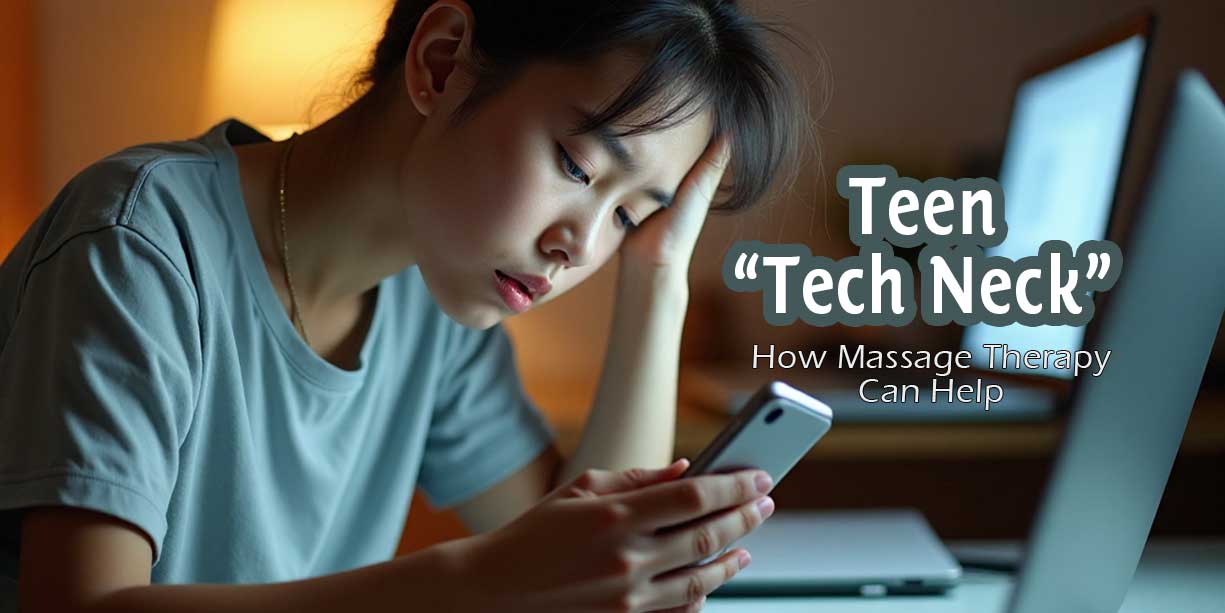
Teen Tech Neck, Exam Stress, and Bad Posture: The Hidden Pain Epidemic Affecting Edmonton Teenagers
Picture a typical teenager’s day. They wake up and check their phone. They sit through six hours of school, hunched over a desk or laptop. They come home, drop their backpack, and either crack the books at the kitchen table or fall into the couch for a gaming session. By the time they’re done with homework, it’s late, their neck hurts, their shoulders are tight, and they’ve probably been looking down at a screen for the better part of twelve hours.
Sound familiar? If you’re a parent in Edmonton, it probably does.
What many families don’t realize is that this daily routine is quietly creating a very real physical problem for young people. It’s called tech neck — and it’s not just an adult issue anymore. Across Canada and around the world, teenagers are showing up with neck pain, headaches, and postural problems that used to be associated with people in their 40s and 50s. The combination of screen time, gaming, study posture, and exam stress is creating the perfect storm for chronic pain at a younger and younger age.
The good news is that it is very treatable — and the sooner it’s addressed, the better the outcome. At The Self Centre in Edmonton, we work with teens and young people to ease the tension, correct postural patterns, and help them feel good in their bodies again. But first, let’s talk about what’s actually going on.
What Is Tech Neck?
Tech neck — sometimes called text neck — is the term used to describe the neck pain, stiffness, and postural changes that result from spending long periods looking down at screens. It sounds simple, but the physics behind it are surprisingly dramatic.
A human head weighs roughly 10 to 12 pounds when held in a neutral, upright position. But as the head tilts forward, the effective load on the cervical spine increases dramatically. At a 15-degree forward tilt, the force on the neck is equivalent to about 27 pounds. At 45 degrees — the angle most people hold their head when looking down at a phone — that load jumps to approximately 49 pounds. Imagine carrying that weight on your neck for several hours a day, every single day. The muscles, joints, and discs of the cervical spine were simply not designed to handle that kind of sustained strain.
Over time, this forward head posture causes the muscles at the back of the neck to become chronically overstretched and fatigued, while the muscles at the front shorten and tighten. The natural curve of the cervical spine begins to flatten. Rounded shoulders develop as the chest tightens and the muscles between the shoulder blades weaken. What starts as occasional soreness can progress to chronic headaches, persistent neck and upper back pain, reduced range of motion, and in more advanced cases, nerve-related symptoms like tingling or aching that radiates down into the arms.
According to Mayo Clinic, bending the head forward at just 45 degrees to look at a phone can dramatically increase the risk of developing tech neck — and with teenagers checking their phones an average of dozens of times per day on top of hours of schoolwork and gaming, the cumulative effect on a developing spine is significant.
Why Teenagers Are Especially Vulnerable
Adults who develop tech neck have typically spent years building postural habits that eventually catch up with them. Teenagers are in a more precarious position: their spines and musculoskeletal systems are still developing. That means the postural adaptations they form now — the forward head, the rounded shoulders, the collapsed core — can become structurally embedded during the very years their bodies are growing and solidifying.
The numbers are striking. Research shows that teenagers spend an average of seven or more hours per day on screens — and that figure does not include school-related screen use. Generation Z as a whole averages close to nine hours of daily screen time. A 2024 Statista report found that 30 percent of children receive their first smartphone between ages 12 and 13, and one in five gets one even earlier. The earlier those habits form, the more time they have to shape developing posture.
A 2024 scoping review published in peer-reviewed research found a 55 percent increase in the use of portable electronic devices following the COVID-19 pandemic, with musculoskeletal pain — especially in the cervical and lumbar regions — emerging as one of the most commonly reported consequences in children and adolescents. More time at home meant more screen time, more remote learning, worse ergonomics, and less movement — a combination that accelerated what was already becoming a concerning trend.
The concern, as one chiropractor put it in a recent Newsweek feature on teen posture, is not just today’s discomfort — it’s what that posture will look like in ten or twenty years if nothing changes.
The Three Big Contributors for Teens: Phones, Gaming, and Studying
1. Smartphones and Social Media
The smartphone is perhaps the single biggest driver of tech neck in teenagers. Unlike a desktop computer, which at least encourages a relatively upright seated posture, a phone is almost always held below eye level — pulling the head forward and down with every scroll, text, and video. The checking behaviour associated with social media compounds the problem: even short, frequent interactions with a phone throughout the day add up to significant cumulative strain on the neck. Because these interactions feel brief and casual, most teenagers — and their parents — don’t recognize them as a source of physical wear.
2. Gaming
Gaming presents its own distinct set of postural challenges. A 2023 study found that four in ten esports players experience regular pain, with the neck being the most common trouble spot. Marathon gaming sessions — particularly those lasting three to five hours or more without breaks — were identified as key risk factors. Gaming also tends to involve a level of physical tension and forward focus that accelerates muscle fatigue: shoulders hunch forward, the jaw clenches, the head drifts toward the screen. The immersive, time-distorting nature of gaming makes it especially difficult for teenagers to recognize when their body is asking them to stop and move.
Whether your teenager is on a console, PC, or mobile device, the postural risks of extended gaming are real and cumulative. And unlike occupational posture problems in adults, gaming happens during the leisure hours that could otherwise be spent moving, stretching, and giving the body a genuine break.
3. Studying, Homework, and Exam Season
If social media and gaming are the recreational contributors to teen tech neck, studying is the academic one — and it may be the most overlooked. Most teenagers do their homework at kitchen tables, on couches, or in bed. Very few have genuinely ergonomic study setups. Laptops are used flat on desks that are too low, encouraging a forward head and rounded upper back. Textbooks are read in the lap. Notes are handwritten with the head dropped over a notebook for extended periods.
During exam season, this problem intensifies dramatically. Study hours spike, physical activity often drops off, and stress levels rise. That last point matters more than many people realize. Psychological stress and physical tension are deeply intertwined. When we are anxious, we tend to carry that tension in the neck, shoulders, and upper back — a pattern that is well-established in the research. For a teenager in the middle of provincial exams or high-stakes tests, the combination of increased screen time, poor study posture, and elevated stress creates a compounded physical burden that the body can struggle to absorb.
Many teens report headaches, neck pain, and shoulder tightness as consistent features of exam periods — and while those symptoms are often chalked up to stress, the physical dimension is equally real and equally worth addressing.
Recognizing the Signs of Tech Neck in Your Teen
Tech neck does not always announce itself loudly at first. Often it starts as mild discomfort that teenagers shrug off or adapt around. Here are the signs worth paying attention to:
- Frequent neck soreness or stiffness, particularly at the end of the day or after studying
- Recurring headaches that seem to start at the base of the skull and radiate forward
- Rounded shoulders and a head that sits noticeably forward of the body when viewed from the side
- Tightness or aching between the shoulder blades
- Difficulty turning the head fully to one side
- Fatigue that seems disproportionate to the amount of physical activity done
- Increased complaints of pain during or after exam periods
If your teenager is regularly mentioning any of these symptoms — or if you’ve noticed a visible change in their posture — it is worth taking seriously. These are not just growing pains. They are signals from the body that something needs to change.
The Posture and Stress Connection: Why Exam Season Makes Everything Worse
It is worth spending a moment on the relationship between stress and physical pain, because it is particularly relevant to teenagers navigating the academic pressures of school.
When the body experiences psychological stress, it activates the sympathetic nervous system — the fight-or-flight response. One of the physical effects of this activation is muscle tension, particularly in the upper trapezius, neck, and shoulder muscles. This is an evolutionary response designed to protect the body in moments of threat. The problem is that for a teenager under chronic academic stress, this system is activated persistently, and the muscles never fully release.
The result is a feedback loop: poor posture creates physical tension, physical tension amplifies stress, and stress drives the body back into a protective, hunched position. For teens who are already dealing with tech neck, exam season can tip a manageable level of discomfort into something genuinely painful and disruptive to sleep, concentration, and mood.
Massage therapy addresses both sides of this loop. It directly relieves the physical tension held in the neck and upper back, and it activates the parasympathetic nervous system — the rest-and-digest response — helping to reduce overall stress levels and promote the kind of calm that allows the body to genuinely let go. For teenagers who carry the weight of school pressure in their shoulders quite literally, a therapeutic massage during exam season can be genuinely transformative.
How Massage Therapy Helps Teen Tech Neck
Massage therapy is one of the most effective hands-on approaches for addressing the muscular and postural effects of tech neck. Our Registered Massage Therapists at The Self Centre in Edmonton use a range of targeted techniques to help teenagers find relief and restore balance to their neck, shoulders, and upper back.
Here is what a massage treatment plan for teen tech neck typically addresses:
Releasing Tight, Overworked Muscles
The upper trapezius, levator scapulae, and suboccipital muscles at the base of the skull are chronically overloaded in tech neck. Therapeutic massage directly targets these areas, using techniques like myofascial release, trigger point therapy, and Swedish massage to reduce tension, increase blood flow, and help the muscles return to a healthier resting length.
Addressing the Chest and Shoulder Muscles
Tech neck is not just a neck problem. The pectoral muscles in the chest and the anterior shoulder muscles tighten and shorten as the rounded posture develops, pulling the shoulders further forward and reinforcing the problem. A thorough treatment plan addresses these areas too, helping to open the chest and bring the shoulders back to a more neutral position.
Reducing Headaches
Many of the tension headaches teenagers experience are cervicogenic — meaning they originate in the neck and radiate upward. By releasing the muscular tension at the base of the skull and along the cervical spine, massage can significantly reduce the frequency and intensity of these headaches. Many clients notice an improvement even after a single well-targeted session.
Calming the Nervous System
As mentioned above, the stress-tension loop is a significant factor in teen tech neck — especially during exam periods. Massage therapy activates the parasympathetic nervous system, helping reduce cortisol levels, slow the heart rate, and promote a genuine state of physical and mental calm. For a teenager who has been running on academic stress and screen fatigue, this can feel like a genuine reset.
Practical Tips for Parents: Reducing Tech Neck at Home
While massage therapy provides real relief, the habits that create tech neck need to change too. Here are some practical steps parents can encourage at home:
- Raise the screen: Whether it is a laptop, tablet, or phone, encourage your teen to bring the screen up to eye level rather than dropping their head to meet it. A simple laptop stand makes a significant difference.
- Create a proper study setup: A desk at the right height, a chair with back support, and a screen positioned at eye level can dramatically reduce the postural load during homework sessions.
- Introduce movement breaks: Encourage your teen to get up and move every 30 to 45 minutes during study or gaming sessions. Even a two-minute walk or stretch breaks the postural cycle.
- Teach the chin tuck: This simple exercise — sitting upright and gently drawing the chin back to create a double chin while keeping the nose level — directly counteracts the forward head position and strengthens the deep neck flexors. Held for five seconds and repeated throughout the day, it is one of the most effective self-care tools for tech neck.
- Watch for exam season warning signs: If your teen starts complaining of headaches or neck pain as exams approach, take it as a cue to book a massage. Getting ahead of the problem is far easier than managing it once it has become acute.
Teen Massage Therapy in Edmonton: The Self Centre
At The Self Centre, we genuinely love working with younger clients. Teenagers deserve the same quality of care and the same respect for their physical well-being as adults — and frankly, getting on top of postural issues in the teen years pays dividends for a lifetime.
Our Registered Massage Therapists are experienced in working with youth and are skilled at adjusting pressure, technique, and communication style to make teenage clients feel comfortable and confident in the treatment space. Many teens who are initially hesitant about massage find that within minutes of a session beginning, they relax completely — often telling us afterward that it was the first time in weeks they had felt that kind of relief.
We offer a calm, welcoming environment at our Edmonton clinic on Ellwood Drive SW — no clinical sterility, no intimidating atmosphere. Just skilled, compassionate care in a space designed to help people of all ages feel at ease.
We also offer direct billing to most major insurance providers, which means tech neck treatment for your teenager may be covered under your extended health plan. Give us a call and we can walk you through the details.
Whether your teen is in the thick of exam season, logged into their gaming setup for the third straight hour, or just waking up every morning with a sore neck that won’t quit — we can help. Call The Self Centre at 780-485-1404 or book online at theselfcentre.com. Their neck will thank them. And honestly? So will their grades.
The Bottom Line
Tech neck is no longer an adult problem. It is showing up in teenagers across Edmonton and across the country — driven by the perfect storm of smartphone use, gaming marathons, poor study ergonomics, and the physical toll of academic stress. The earlier it is caught and addressed, the better the outcome for a developing spine.
Massage therapy is one of the most effective, non-invasive tools available for relieving the pain and tension of tech neck, calming the nervous system, and helping teenagers feel genuinely well in their bodies — not just during exam season, but all year long.
If you are a parent in Edmonton who has noticed your teenager rubbing their neck, complaining of headaches, or sitting in a way that makes you wince — this is your sign. Come see us at The Self Centre. We’re here for the whole family.
Please note: This article is for informational purposes only and does not constitute medical advice. If your teenager is experiencing persistent neck pain, headaches, or postural concerns, please consult a qualified healthcare professional.