

Lymphatic Drainage Massage: How to Open the 7 Key Pathways for Better Flow
If you have been on YouTube or social media lately, you have probably seen the videos. Someone stands in front of a camera, rubs behind their ears, moves down to their collarbone, works their armpits, belly, and knees, finishes with a set of slow calf raises, and tells you their energy changed, their puffiness disappeared, and they have been doing it every morning since. And the comments are flooded with people saying the same thing happened to them.
The technique is called the Big 6 — or in the version we cover here, a 7-point sequence that includes the ankles for a complete lower-body finish. It was popularized by Dr. Perry Nickelston of Stop Chasing Pain, and it has sparked more genuine interest in the lymphatic system than decades of clinical literature ever managed. Whether you are new to the concept or looking to understand why it actually works, this guide covers the science behind it, how to do each step correctly at home, the tools that can help, and when it is time to let a professional take over.
At The Self Centre Massage & Wellness Clinic in Edmonton, our registered massage therapists offer professional Manual Lymphatic Drainage — the clinical, anatomy-based technique that home routines are modelled on.
Why Your Lymphatic System Needs Your Help
Your lymphatic system is one of the most important and least understood systems in your body. It is a vast network of vessels and nodes that runs alongside your circulatory system, collecting excess fluid from your tissues, filtering out waste and pathogens, transporting immune cells, and returning clean fluid to your bloodstream.
Here is the catch: unlike your blood, which has the heart to pump it constantly, lymph fluid has no dedicated pump. It moves entirely through muscle contractions, breathing, and movement. When you are active, well-hydrated, and sleeping well, the lymphatic system hums along quietly doing its job. But when you sit for long hours, travel, eat poorly, experience chronic stress, or recover from illness or surgery, lymph flow can slow to a crawl. Fluid accumulates in the tissues. Waste products linger. Your immune response slows. The result is a constellation of symptoms that many people just accept as normal: persistent puffiness, fatigue, brain fog, swollen ankles, frequent illness, sinus congestion, and that general feeling of being waterlogged and heavy.
Lymphatic drainage massage — whether done at home or by a trained professional — works by manually stimulating the lymphatic vessels and nodes to keep the system moving. The key is understanding where the major node clusters are and how to work them in the right sequence.
The Order Matters: Open the Drain First
The most important principle behind any lymphatic drainage sequence is this: you must work from the drainage points outward. The lymphatic system flows from high pressure zones in the extremities toward low pressure zones near the collarbone, where the fluid ultimately re-enters the bloodstream. If you start rubbing your ankles or legs without first clearing the nodes higher up in the chain, you are pushing fluid toward a closed drain.
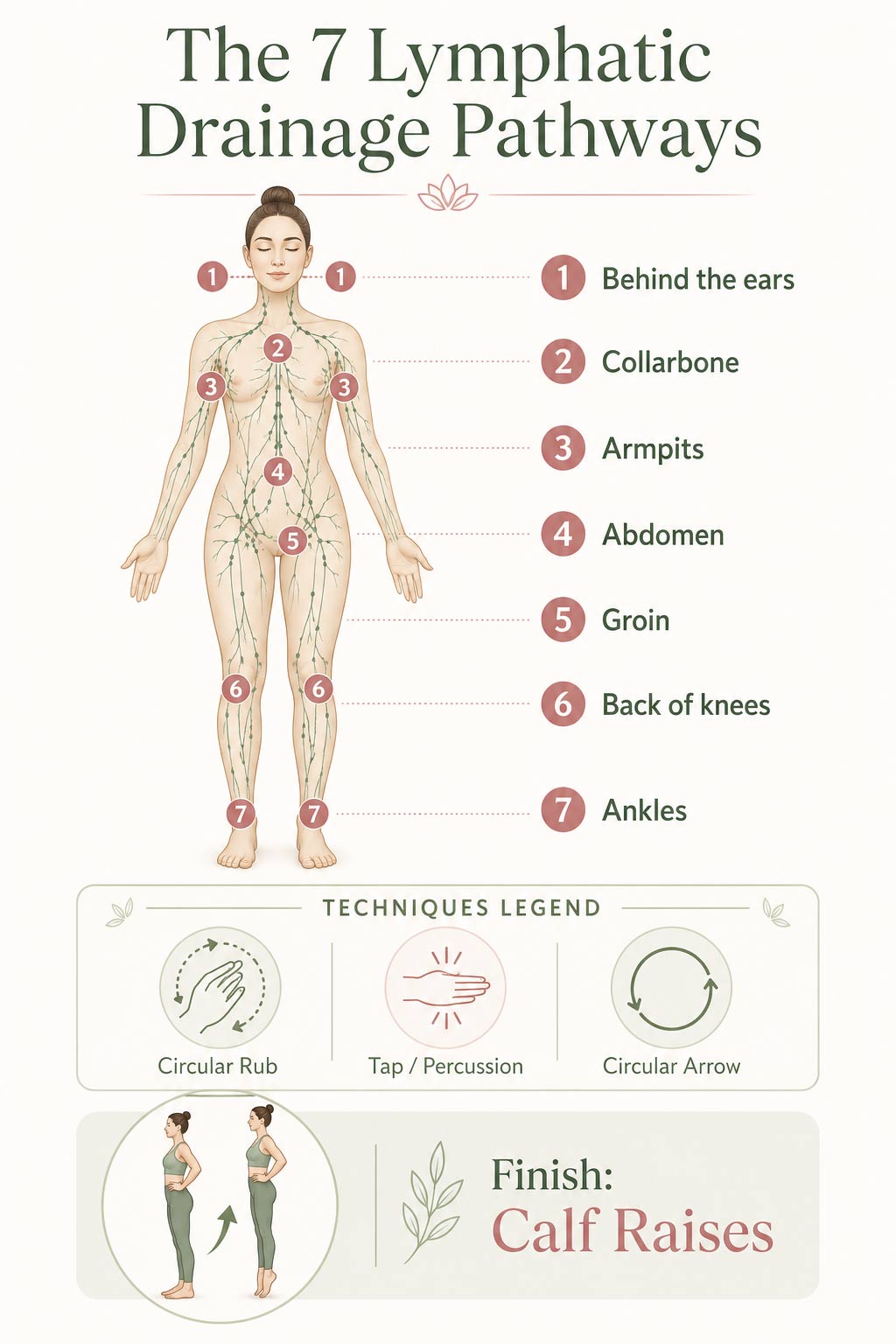
The 7-point sequence below works the body from the top down, clearing each station before stimulating flow from the areas below it.
At each point, the technique is the same: First, rub the area with gentle circular pressure for about 20 to 30 seconds to warm the tissue and engage the superficial lymphatic vessels just under the skin. Then tap the same area firmly but gently for 30 to 45 seconds — the vibration activates the lymph nodes and helps loosen minor congestion. Then finish with slow, deliberate circular motions for another 20 to 30 seconds to encourage fluid to move toward the next station. The pressure throughout should be lighter than you expect. If you can feel muscle underneath your fingers, you are pressing too hard. Seventy percent of the lymphatic vessels sit just beneath the skin and respond to the gentlest touch.
Point 1: Behind the Ears (Cervical Nodes)
The area just behind and below your ears, where the jaw meets the neck, contains some of the largest and most active lymph nodes in the upper body. These cervical nodes drain the head, face, scalp, and sinuses. Opening them first ensures that when you stimulate flow from the neck and upper body, the fluid from the head has somewhere to go.
Place your fingertips just behind your earlobes and at the base of your skull. Rub in gentle circles, then tap, then use slow circular strokes pulling downward toward your neck. Spend about 60 to 90 seconds total on each side. This is the step many people feel most immediately — if your sinuses are congested or you have a tension headache, you may notice a shift during this step alone.
Point 2: The Collarbone (Subclavian Nodes)
This is the master drainage site for the entire body. All lymph fluid — from your toes to your fingertips to the top of your head — ultimately empties into the subclavian veins just below your collarbones, where it re-enters the bloodstream. Clearing this point is the foundation of any effective lymphatic drainage routine.
Using your fingertips, rub the area above and below your collarbones, then tap firmly, then finish with slow circular motions. Work both sides. Spend at least 60 seconds here. Think of this as opening the main drain before everything else flows toward it.
Point 3: Under the Arms (Axillary Nodes)
The axillary nodes sit in the hollow of each armpit and are responsible for filtering lymph from the entire arm, shoulder, chest wall, and breast tissue. This is one of the most significant clusters in the body, and one of the most commonly congested — particularly for people who sit at a desk, use their arms heavily, or wear tight clothing across the chest.
Place your fingertips of your right hand into the hollow of your left armpit, reaching gently into the centre. Rub, tap, then use slow circular movements pushing inward toward the body. Repeat on the other side. Keep the pressure feather-light — this area is sensitive and the vessels are close to the surface.
Point 4: The Abdomen (Mesenteric Nodes)
The abdomen contains one of the highest concentrations of lymph nodes in the body, many of them deep inside and tied directly to digestion, gut immunity, and the movement of fats and nutrients from food. When abdominal lymph flow is sluggish, it can contribute to bloating, digestive discomfort, and a general sense of heaviness after eating.
Place your fingertips between your ribcage and navel and rub in gentle clockwise circles — always clockwise, following the natural direction of the colon. Then tap, then continue the circular pattern with slightly wider, slower strokes. Taking several slow, deep breaths during this step makes it significantly more effective, as the movement of the diaphragm acts as a natural pump for the deep abdominal lymphatics.
Point 5: The Groin (Inguinal Nodes)
The inguinal nodes sit in the crease where your thigh meets your pelvis on each side, and they are the gateway for lymph returning from the entire lower body. Everything from your legs, lower abdomen, and pelvic region has to pass through here. For anyone who sits for extended periods, deals with lower body swelling, or struggles with lipedema, this is one of the most impactful points in the sequence.
Press gently into the hip-leg crease on each side with your fingertips and follow the full technique — rub, tap, circle. Keep the pressure light and the movements slow. Opening this point before you move to the knees and lower legs is essential — it is what gives the fluid from below somewhere to drain.
Point 6: Back of the Knees (Popliteal Nodes)
Tucked behind each knee in the popliteal fossa is a cluster of small but important lymph nodes that drain the lower leg, the knee joint itself, and the foot. Fluid from this area feeds directly into the inguinal nodes in the groin above — which you have already cleared — making this step work with maximum efficiency.
Reach behind each knee and use your fingertips to rub the hollow gently, then tap, then finish with slow upward-directed circular motions encouraging flow toward the thigh. This can be done standing, seated, or lying on your back with your knees bent. Many people with lower leg swelling, post-surgical fluid retention, or general leg heaviness find this point especially relieving.
Point 7: The Ankles (Tibial Nodes)
While not part of the original Big 6, many practitioners add the ankles as a seventh step to complete the lower body sequence. The inner ankle area corresponds to the saphenous lymphatic vessels that run up the inner leg toward the popliteal and inguinal nodes. For anyone dealing with ankle swelling, foot puffiness, or circulation issues in the lower legs, this addition can make a meaningful difference.
Wrap your fingers around each ankle and apply gentle circular massage on the inner ankle specifically, then tap, then finish with slow upward strokes along the lower leg toward the knee. Work one ankle at a time and keep all pressure light.
Finish: Calf Raises to Pump the Lymph
Every effective lymphatic drainage sequence ends with movement, and the calf raise is the most targeted finish you can do. Slowly rise up onto your toes, hold for a breath, then lower your heels back down. Repeat this 20 to 30 times at a steady, unhurried pace.
The calf muscles are sometimes called the second heart of the lymphatic system. The pumping action of rising and lowering on your toes compresses and releases the lymphatic vessels in the lower legs, driving fluid upward through the chain of nodes you have just opened. This is why standing and walking are so important for lymphatic health in general — and why long periods of sitting are so hard on the system.
Home Tools That Support Lymphatic Drainage
Your hands are the most accessible tool you have, but a few additions can meaningfully enhance your home practice.
Silicone cupping creates a gentle suction lift that decompresses the superficial tissue and directly engages the lymphatic vessels just beneath the skin. Used with slow, light gliding strokes in the direction of lymph flow, cupping is particularly effective on the limbs and abdomen. This works best in the shower with soapy skin.
Percussion massage devices used at their lowest setting and softest attachment can provide gentle vibration over the major node points — particularly the armpits, abdomen, and groin — to help activate flow. This is not the time for deep tissue percussion. Keep it gentle and superficial.
Dry brushing before a shower using a natural bristle brush stroked toward the heart is a simple daily habit that stimulates the skin and the superficial lymphatics simultaneously. Rebounding on a mini trampoline — even five to ten minutes daily — is considered one of the most effective full-body lymphatic exercises because the up-down motion activates lymphatic valves throughout the entire body at once.
When Professional Manual Lymphatic Drainage Is the Better Choice
The home routine described above is genuinely useful for healthy people maintaining everyday lymphatic flow. But for anyone managing a specific condition — lymphedema, lipedema, post-surgical swelling, chronic inflammatory conditions, or immune challenges — professional Manual Lymphatic Drainage (MLD) provides a level of precision and therapeutic depth that self-massage cannot replicate.
A trained therapist works with detailed knowledge of lymphatic anatomy, applying calibrated pressure in the exact direction of lymph flow for each region of the body. The technique is adapted to your specific health history, conditions, and treatment goals. Sessions are methodical, anatomy-based, and clinically effective in a way that no YouTube video can fully teach.
At The Self Centre Massage & Wellness Clinic in Edmonton, we have registered massage therapists that can provide professional Manual Lymphatic Drainage in 60 and 90 minute sessions, in a calm and welcoming environment. We offer direct billing to most major insurance providers.
Whether you are maintaining your practice with the home routine or ready for a professional session to address something more specific, lymphatic drainage massage is one of the most powerful wellness habits you can build. Your lymphatic system does its best work when you work with it — consistently, gently, and in the right order.
Book your lymphatic drainage massage in Edmonton online or call 780-485-1404.
The Self Centre Massage & Wellness Clinic | 2324 Ellwood Dr SW, Edmonton, AB | Open 7 days a week
