

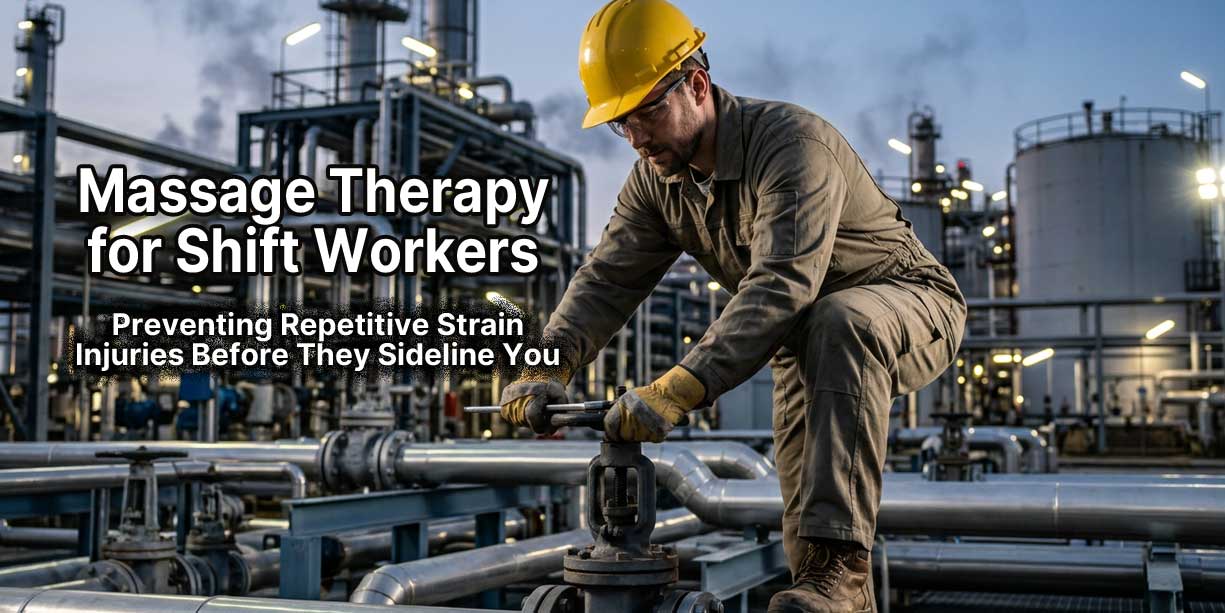
Why Shift Workers Are at Higher Risk for Repetitive Strain Injuries
If you work rotating shifts, spend stretches of time in a camp, or move between physically demanding contracts and desk-based downtime, your body is absorbing a compounding kind of punishment that most people never have to think about. It isn’t just the heavy lifting, the awkward postures, or the hours on your feet — it’s the relentlessness of it all, piled on top of disrupted sleep, minimal recovery time, and the physical transitions between radically different work demands. Repetitive strain injuries (RSIs) thrive in exactly these conditions, and for shift workers across industries like oil and gas, trades, construction, healthcare, and emergency services, the risk is measurably higher than for those keeping regular hours.
The good news is that massage therapy is one of the most effective, evidence-backed tools available for preventing RSIs before they become chronic problems — and for managing the broader physical and psychological toll that shift work takes on the body. Here is what the research tells us, and why making massage therapy part of your regular routine is not a luxury; it is injury prevention.
The Real Physical Cost of Shift Work
Before understanding how massage helps, it is worth being clear about what shift workers are actually up against. A review of 23 peer-reviewed publications examining musculoskeletal disorders and work schedules found that eight studies controlling for physical job demands consistently reported a significant increase in one or more measures of musculoskeletal disorders (MSDs) in workers logging long hours. ScienceDirect This is not a minor statistical uptick — it represents a pattern playing out across industries wherever demanding schedules are the norm.
Research using data from the Fourth Korean Working Conditions Survey found that long working hours independently increased workers’ prevalence of work-related musculoskeletal symptoms, even after adjusting for occupational characteristics and psychosocial factors. Specifically, working more than 13 hours per day was identified as a significant risk factor for neck, shoulder, and back disorders. PubMed Central
For camp workers and rotational employees specifically, the issue is compounded by the nature of the schedule itself. Two weeks on, one week off, or similar rotation patterns create cycles of intense physical loading followed by periods of relative inactivity — often involving long hours of sedentary travel or desk work between site assignments. According to a systematic review published in the International Journal of Environmental Research and Public Health, probable causes of musculoskeletal disorders include maintaining uncomfortable postures for prolonged periods, lifting excessive loads, a sedentary lifestyle, and working excessively long shifts — a combination that describes the reality of most rotational work environments. CDC
A systematic review of longitudinal studies on work-related musculoskeletal disorders identified heavy physical work, high psychosocial work demands, and excessive repetition and awkward postures as risk factors with at least reasonable evidence of a causal relationship — all hallmarks of physically demanding shift work. PubMed
What Is a Repetitive Strain Injury?
RSIs are injuries to muscles, tendons, nerves, and ligaments caused by repetitive motion, sustained awkward postures, or overuse without sufficient recovery. They include conditions like carpal tunnel syndrome, tendinitis, rotator cuff injuries, tennis elbow, thoracic outlet syndrome, and plantar fasciitis. What makes RSIs particularly dangerous for shift workers is how gradually they develop.
One of the most common forms of repetitive strain injuries involves peripheral nerves. As these peripheral nerves pass through the body, they may be exposed to mechanical deformation or chemical irritation during repetitive limb movements. Ongoing mechanical irritation can contribute to the development of post-inflammatory fibrosis and diffuse nerve inflammation.
This process is insidious. There is typically a long window of early warning signs — mild discomfort, stiffness after a shift, reduced grip strength, or intermittent tingling in the hands — before an injury becomes disabling. Most shift workers push through these signals mid-rotation when stopping is not an option. By the time they are off-site and could address the issue, it feels manageable enough to ignore. This is how acute overuse becomes a chronic, career-altering condition.
How Massage Therapy Interrupts the RSI Cycle
Massage therapy works on RSI prevention through several distinct, well-documented mechanisms — from direct changes in soft tissue to systemic effects on inflammation, nerve health, and hormonal function.
Reducing Inflammation Before Fibrosis Takes Hold
The most compelling research on massage and RSI prevention focuses on its ability to interrupt the inflammatory cycle before scar tissue develops. Research using modelled massage has shown that attenuating the inflammatory response in the early stages of an injury may help prevent the development of musculoskeletal disorders in forearm nerves, muscles, and tendons. A study published in The Journal of Neurological Sciences found that soft-tissue massage prevented the deposition of collagen and transforming growth factor beta-1 (TGF-β1) in the nerves and connective tissues of the forearm — key drivers of the fibrotic changes that turn manageable overuse into long-term disability.
This is where massage therapy earns its place in a prevention strategy rather than just a recovery plan. The window of opportunity is early intervention — before tissue changes become structural and before symptoms become severe enough to require time off work.
Improving Circulation and Tissue Resilience
Research on the mechanisms of massage indicates that mechanical pressure helps increase blood flow by increasing arteriolar pressure and muscle temperature. Depending on the technique used, massage also modulates neural excitability, reduces anxiety, and produces a measurable relaxation response through changes in parasympathetic activity — including decreases in heart rate, blood pressure, and cortisol levels. AMTA
For workers who spend long shifts on their feet, operating machinery with sustained grip, or alternating between physical labour and desk work between contracts, this circulatory and neurological benefit is invaluable. Tissues that are well-perfused recover faster, are more resilient to repetitive stress, and are far less likely to develop the adhesions and restricted movement that cause chronic pain.
A systematic review and meta-analysis examining the effects of sports massage found that massage produces a small but significant improvement in flexibility compared to no intervention, and provides a meaningful benefit in reducing or preventing delayed onset muscle soreness (DOMS) — the type of tissue inflammation that accumulates with repeated physical loading.
Supporting Nerve Health and Preventing Nerve-Related RSIs
Nerve-related RSIs — including carpal tunnel syndrome, cubital tunnel syndrome, and thoracic outlet syndrome — are common among workers who perform repetitive grip tasks, vibration-heavy work, or sustained forward postures. Research has shown that soft tissue massage and nerve-directed stretching may help disperse intraneural edema and flush inflammatory cells — including cytokines and chemokines — from the injured area. Peripheral nerves themselves also respond to appropriate nerve-directed stretching, with improvements in nerve excursion correlating with decreases in pain and disability.
Skilled massage therapists can target the soft tissue surrounding peripheral nerves to reduce compression, improve glide, and decrease the mechanical irritation that drives nerve-related RSIs. This is proactive tissue management, not reactive pain treatment.
Addressing the Full Musculoskeletal Picture
A systematic review published in BJSM confirms that massage therapy, as a standalone treatment, reduces pain and improves function compared to no treatment in a range of musculoskeletal conditions. For shift workers, this matters across every body region — from the lumbar spine under load during physical work, to the cervical spine compressed by prolonged device use during desk-based periods, to the shoulders and wrists bearing the brunt of repetitive tool operation.
The Sleep and Recovery Connection
One of the most underappreciated aspects of injury prevention for shift workers is the role of sleep. Recovery from physical labour — the process by which muscles repair, inflammation resolves, and the nervous system resets — happens predominantly during sleep. Shift workers, by definition, have compromised sleep. The disruption to circadian rhythm that comes with rotating or night shifts directly interferes with the body’s capacity to recover between demanding workdays.
A widely cited review published in the International Journal of Neuroscience found that massage therapy produces significant decreases in cortisol levels, averaging a 31% reduction, alongside average increases of 28% in serotonin and 31% in dopamine across studies on stress, pain, and a range of medical conditions. PubMed Central
Massage therapy promotes relaxation and reduces stress by acting on the body’s nervous system. The tactile stimulation that occurs during a session decreases cortisol — a stress hormone — and increases serotonin, a neurotransmitter that serves as a precursor to melatonin, the hormone responsible for regulating the sleep-wake cycle. For a shift worker whose circadian rhythms are already disrupted, this hormonal support can mean the difference between genuinely restorative rest and another incomplete sleep cycle that leaves the body more vulnerable the next day.
Research published in PMC found that massage therapy can improve mental and physical health by increasing levels of dopamine and serotonin while reducing cortisol and norepinephrine — effects associated with lower anxiety, better sleep, and fewer depressive symptoms.
Better sleep produces better tissue recovery. Better tissue recovery means muscles, tendons, and nerves are less susceptible to the cumulative microtrauma that causes RSIs. For shift workers, this chain of causation is not abstract — it is the difference between arriving home from a rotation healthy and returning from one with a shoulder injury that sidelines them for weeks.
Managing the Physical Toll of Desk Work Between Contracts
Many shift workers and camp employees perform substantial amounts of sedentary desk work between or during contracts — administrative tasks, safety documentation, planning meetings, or the administrative realities of site office work. The transition from heavy physical labour to prolonged sitting, and back again, creates its own set of musculoskeletal risks that are often overlooked.
Sustained sitting in a forward-flexed posture loads the cervical and lumbar spine, tightens the hip flexors, and places the shoulders in a protracted, internally rotated position. When you return to physical work from extended desk periods without addressing this postural decompensation, injury risk climbs sharply. A systematic review of computer-related musculoskeletal disorders found that work-related MSDs are the most common cause of occupational illness in the United States, costing the sector between $45 and $54 billion annually — with neck and upper extremity disorders being the most prevalent among sedentary workers. CDC
Massage therapy targeting the neck, upper trapezius, thoracic spine, and hip flexors can help reverse the postural consequences of desk periods, restore tissue mobility, and physically prepare the body for the demands of a return to active site work. This is one of the most practical applications of massage for rotational workers and one of the most commonly overlooked.
Why Consistency Matters More Than Frequency
Many workers approach massage as a one-time reward after a long rotation rather than a consistent maintenance strategy. The research supports a different model. Studies from the Touch Research Institute demonstrate that even brief 15-minute chair massages in workplace settings can significantly reduce stress biomarkers, indicating that massage therapy does not require extensive time commitments to deliver meaningful physiological benefits — and that consistency may matter more than duration.
Research also suggests that regular sessions create lasting physiological changes, with the body appearing to respond more efficiently to subsequent treatments over time — indicating that massage may help retrain the stress response and build more resilient biological systems.
For shift workers, this is both practical and encouraging. You do not need a 90-minute session every week to accumulate meaningful benefit. Building regular treatment into your off-rotation — even monthly — creates tissue health that compounds over time, making injury less likely during the demanding periods when you cannot afford to stop.
Massage Therapy as a Proactive Investment in Your Working Life
The culture in many industries where shift work is common — trades, oil and gas, forestry, healthcare, emergency services — tends to view massage as something you pursue after an injury, not before one. This is a costly approach. A systematic review in PLOS ONE found that musculoskeletal disorders significantly impair workers’ quality of life and are associated with high costs for employers, including absenteeism, lost productivity, and increased costs for disability and workers’ compensation claims. PubMed Central
Massage therapy reframes this entirely. It is not about pain management after the fact — it is about maintaining tissue quality, interrupting the inflammatory cycle early, supporting recovery between rotations, improving sleep, managing the physical consequences of desk work between contracts, and building resilience into a body that is being asked to perform under genuinely demanding conditions, day after day.
If you are a shift worker in the Edmonton area looking to get ahead of repetitive strain before it becomes a long-term issue, The Self Centre offers registered massage therapy with an understanding of the demands that physically intensive, rotational, and long-hour work places on the body. Whether you are between rotations, freshly off a camp stint, or simply trying to stay functional and injury-free through a demanding contract season, professional massage therapy is one of the most evidence-based investments you can make in the career and physical health you depend on.
Your livelihood depends on what your body can do. Protecting it is not an afterthought — it is part of the job.
References
- Bove GM et al. (2016). Soft tissue massage reduces inflammation and fibrosis in a model of repetitive strain. Journal of Neurological Sciences. Referenced via Richard Lebert RMT
- Weerapong P, Hume PA, Kolt GS. (2005). The mechanisms of massage and effects on performance, muscle recovery and injury prevention. Sports Medicine. PubMed
- Bervoets DC et al. (2015). Massage therapy has short-term benefits for people with common musculoskeletal disorders. British Journal of Sports Medicine. PubMed
- Kim MS et al. (2018). Long working hours and work-related musculoskeletal symptoms. BMC Musculoskeletal Disorders. PMC
- Lipscomb JA et al. (2006). A review of work schedule issues and musculoskeletal disorders with emphasis on the healthcare sector. American Journal of Industrial Medicine. PubMed
- Ruiz-Frutos C et al. (2024). Work-related musculoskeletal disorders: A systematic review and meta-analysis. International Journal of Environmental Research and Public Health. PMC
- da Costa BR, Vieira ER. (2009). Risk factors for work-related musculoskeletal disorders: A systematic review. Journal of Rehabilitation Medicine. PubMed
- Field T et al. (2005). Cortisol decreases and serotonin and dopamine increase following massage therapy. International Journal of Neuroscience. PubMed
- Marková V et al. (2025). Massage positively influences daytime brain activity and reduces arousal in poor sleepers. PMC. PMC
- Dupuy O et al. (2020). Effect of sports massage on performance and recovery: A systematic review and meta-analysis. British Journal of Sports Medicine. PMC
- Alqurain H et al. (2024). Work-related musculoskeletal disorders among computer workers. ScienceDirect. ScienceDirect
This article is for informational purposes and does not constitute medical advice. Consult a registered healthcare professional for assessment and treatment of any injury or condition.