

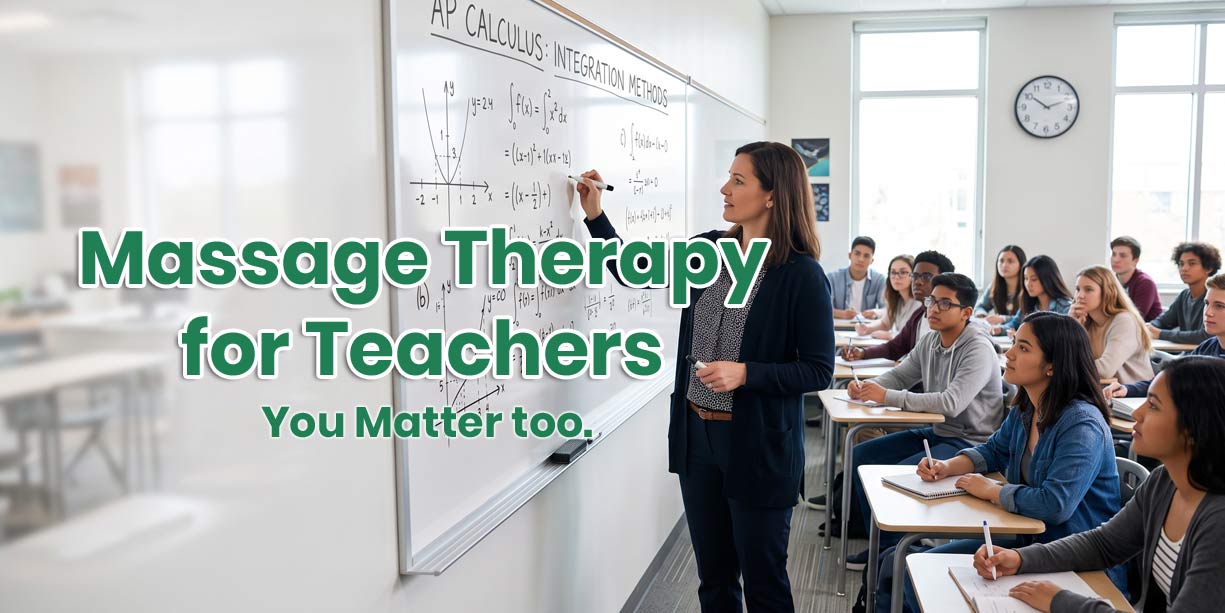
You Have Given Everything to Your Students All Year. Now It Is Your Turn
September to June is a long haul. You have managed classrooms, marked hundreds of assignments, handled parent concerns, adapted lesson plans on the fly, supervised field trips, supported kids going through hard times, sat through staff meetings, and somehow found the energy to show up every single day and give it your best. You have poured yourself into your work in a way that most people outside the profession will never fully understand. And your body has been carrying every bit of it. Massage therapy for teachers is not something most people think about until the tension becomes impossible to ignore — but it should be the first thing on your list when that last bell rings in June.
And now it is summer.
The question is: what are you actually going to do with it? If past summers are any indication, the answer might be a week or two of decompressing, followed by your brain quietly starting to prep for September whether you want it to or not. The tension in your shoulders from standing at a whiteboard for nine months does not disappear just because school is out. The fatigue that has built up since Thanksgiving does not vanish with the last bell.
Your body has been carrying a lot. And it is asking you, right now, to do something about it.
At The Self Centre Massage and Wellness in Edmonton, we see teachers every summer. We know what a body that has been running on adrenaline and caffeine and genuine love for the job feels like on the table. And we know how different you feel when you walk out. This article is our note to you: what is actually happening in your body after a school year, why teachers specifically are at such high risk for burnout and physical breakdown, and how massage therapy can start to undo some of that damage before September rolls back around.
What Teaching Does to Your Body
Teaching is classified as a high-demand occupation, and the research backs that up thoroughly. The teaching profession is associated with occupational stress resulting from the specific physiological, psychological, and physical demands of the work, with teachers citing psychosomatic disorders and burnout symptoms as the main reason for higher turnover rates and early retirement compared to other areas of public service. Teachers also report significantly elevated rates of musculoskeletal disorders including back pain, neck and shoulder pain, and upper and lower arm pain.
In plain terms: teaching wears your body out in ways you can see and feel and also in ways that build quietly over time.
Think about a typical school day. You stand for most of it. You crane your neck to watch the back of the room. You hunch over a desk to help a student. You carry bags, manage noise levels, moderate conflict between kids, and manage your own emotional response to all of it while maintaining authority and warmth at the same time. That is an enormous amount of physical and emotional output, sustained for six hours a day, five days a week, ten months of the year.
The neck and shoulders tend to bear the brunt of it. Prolonged standing, poor classroom ergonomics, and the postural demands of writing on boards or watching a room full of kids all day contribute to chronic muscle tension that most teachers barely notice anymore because it has become their normal. Lower back pain is also extremely common, particularly for teachers who spend significant time seated at a desk for marking or preparation.
And then there is the nervous system. The constant low-level vigilance of managing a classroom keeps your sympathetic nervous system, the fight or flight system, in a state of readiness all day long. Over time this becomes your baseline. You go home still switched on. You struggle to sleep. You wake up tired. The summer arrives and your body does not know how to stand down.
The Burnout Numbers Are Not Small
If you have ever felt like you were running on empty by April, you are not alone and you are not exaggerating. A Canadian study surveying nearly 800 elementary and high school teachers across three provinces found that the prevalence of emotional exhaustion was 76.9%, while 30.8% reported a lack of professional accomplishment. Teachers with high stress symptoms were nearly seven times more likely to experience emotional exhaustion than those with lower stress levels. Frontiers
Nearly seven times more likely. That is not a small difference. And emotional exhaustion is not just about feeling tired. It is a state of depletion that affects your immune system, your sleep, your relationships, your physical health, and your ability to experience joy. It is what happens when you give more than you are able to replenish, over and over, for years.
The summer break matters enormously. But it is not enough on its own if you spend it waiting to recover passively. Your body needs active support to come down from the level of chronic stress that a school year builds.
What Massage Therapy Does for Occupational Stress
This is not just about feeling relaxed for an hour. The research on massage therapy for occupational stress is increasingly clear and compelling.
Research on massage therapy for workers in high-stress occupations has found that chronic exposure to workplace stressors leads to burnout, psychosomatic complaints, and measurable reductions in quality of life and work performance. Physical relaxation approaches including massage therapy have demonstrated meaningful effects on reducing these outcomes. PubMed Central
What happens in the body during a massage session is not passive. Your heart rate slows. Cortisol, the primary stress hormone, begins to drop. Your muscles receive increased blood flow and oxygen. The tension patterns that have built up in your neck, shoulders, and back over months of classroom work begin to release. And perhaps most importantly for teachers, the nervous system begins to shift from sympathetic dominance, that constant state of readiness, toward parasympathetic activity. Rest and digest mode. The state your body needs to be in to actually recover.
A study published in the Journal of Occupational and Environmental Medicine specifically examining massage therapy and burnout risk found that regular massage reduced burnout indicators in employees across high-stress occupations, supporting its role as a practical and effective tool for occupational stress management. PubMed Central
For teachers, this means regular massage therapy during the school year and especially during summer break can meaningfully reduce the accumulated physical and emotional load before it compounds into something harder to address.
The Physical Benefits Teachers Notice Most
While the stress and burnout research is compelling, teachers who come to The Self Centre often tell us the most immediate relief comes from the physical side.
Neck and shoulder tension is the most common complaint we hear. Nine months of classroom posture, writing on boards, looking out over a room, and carrying heavy bags creates deep, chronic tension in the upper trapezius and cervical muscles that a hot shower simply cannot reach. Registered Massage Therapy uses specific techniques to release those patterns and restore normal muscle function and range of motion in a way that feels almost immediate.
Lower back pain is the second most common issue. Whether from long periods of standing, sitting at a desk for marking, or the general fatigue that settles into the lumbar region by midwinter, the lower back in teachers tends to carry a significant load. Targeted therapeutic work in this area brings relief that many teachers have stopped believing was possible.
Headaches are another issue that shows up frequently. Tension headaches driven by tight muscles in the neck, upper back, and base of the skull are directly addressable through massage. Many clients who come in with regular headaches notice a significant reduction in frequency and intensity with consistent treatment.
And then there is sleep. The nervous system regulation that comes with regular massage therapy has a well-documented effect on sleep quality. When your body learns to come down from its state of high alert through regular parasympathetic activation, sleep improves. And better sleep over the summer means you head back to September actually rested rather than just slightly less depleted.
Why Summer Is the Right Time to Start
Summer is the obvious time to begin, but it is also genuinely the best time strategically. You have more flexibility in your schedule. The pressure is off. Your body is already beginning to shift, and giving it professional support right now accelerates that process significantly.
But here is the thing worth thinking about: the teachers who get the most benefit from massage therapy are the ones who do not stop in September. The ones who keep a regular monthly or biweekly appointment through the school year are the ones who come back the following summer in meaningfully better shape than the year before. Because the work builds on itself. Each session continues what the last one started. The tension does not fully rebuild between sessions the way it does when you go months without treatment.
Starting in summer means starting when your body is most ready to receive it. And continuing into the school year means you are managing the load as it accumulates rather than waiting until June to try to undo nine months of it at once.
Direct Billing Means One Less Barrier
Many teachers have extended health benefits through their union or employer, and Registered Massage Therapy is covered under most plans. At The Self Centre in Edmonton, we offer direct billing to most major insurance providers, which means you do not need to pay out of pocket and wait for reimbursement. You just show up, bring your insurance card, and we handle the rest.
If you are not sure whether your plan covers massage therapy, the answer is almost certainly yes. Most Alberta teacher benefit plans include RMT coverage. Call us and we can help you figure it out before your appointment.
You Have Spent All Year Showing Up for Everyone Else
You know that speech about putting your own oxygen mask on first? Teachers are famously bad at following that advice. The job rewards selflessness and punishes absence, which creates a culture of pushing through long after the body and mind are asking to slow down.
But you cannot pour from an empty cup. And you know that better than most because you have watched what happens to colleagues who run themselves into the ground. The ones who make it to retirement feeling good, feeling energized, and still genuinely loving what they do are the ones who figured out that taking care of themselves was part of the job, not a break from it.
This summer, make an appointment. Not as a luxury. As a professional decision. Your students next September will get a better version of you because of it. And you will get to feel, even just for a session, what it is like to have someone focused entirely on how you are doing.
You have earned that. Several times over.
Book your massage therapy appointment in Edmonton online at The Self Centre.