
Why Edmonton Winters Are Especially Hard on Your Nervous System
Edmonton winters are tough. With only a few hours of daylight between November and February, temperatures dropping far below freezing, and a winter season that can last six months or more, residents face real challenges to their mental and physical health. Research has found that Edmonton’s northern location means winter sunlight isn’t strong enough to help our bodies make vitamin D, which affects our mood and stress levels. As our bodies respond to these long, dark, cold months, many Edmontonians struggle with anxiety, poor sleep, constant tension, and feeling overwhelmed. This is where massage therapy becomes more than just nice to have—it becomes essential for our nervous system health.
At The Self Centre in South Edmonton, we understand that winter’s impact goes beyond feeling cold. Your body’s nervous system responds to stress in powerful ways, and massage therapy offers a science-backed way to restore balance and calm during the hardest months of the year.
Understanding Your Nervous System and Winter Stress
Your nervous system has two main parts: the sympathetic nervous system, which controls your fight-or-flight response, and the parasympathetic nervous system, which controls rest, digestion, and recovery. When these systems are balanced, you can handle stress and then return to feeling calm.
However, Edmonton winters create a perfect storm of stress that keeps your fight-or-flight system constantly turned on. Less sunlight messes with your sleep schedule and affects the chemicals in your brain that control mood and sleep. Studies on seasonal changes in Canadian populations have found that depression symptoms increase a lot during winter months, especially in northern cities like Edmonton. The constant cold forces your body to burn more energy just to stay warm. People stay inside more, leading to social isolation. All of these factors combine to keep your nervous system on high alert.
When your nervous system gets out of balance, you might notice tight muscles, especially in your neck, shoulders, and jaw, trouble sleeping or never feeling rested, stomach problems, constant anxiety or feeling on edge, pain that seems worse in winter, difficulty focusing or brain fog, and feeling disconnected from your body. Research shows that people living far from the equator, where winter days are very short, are at higher risk for seasonal mood problems. This makes Edmonton residents especially vulnerable.
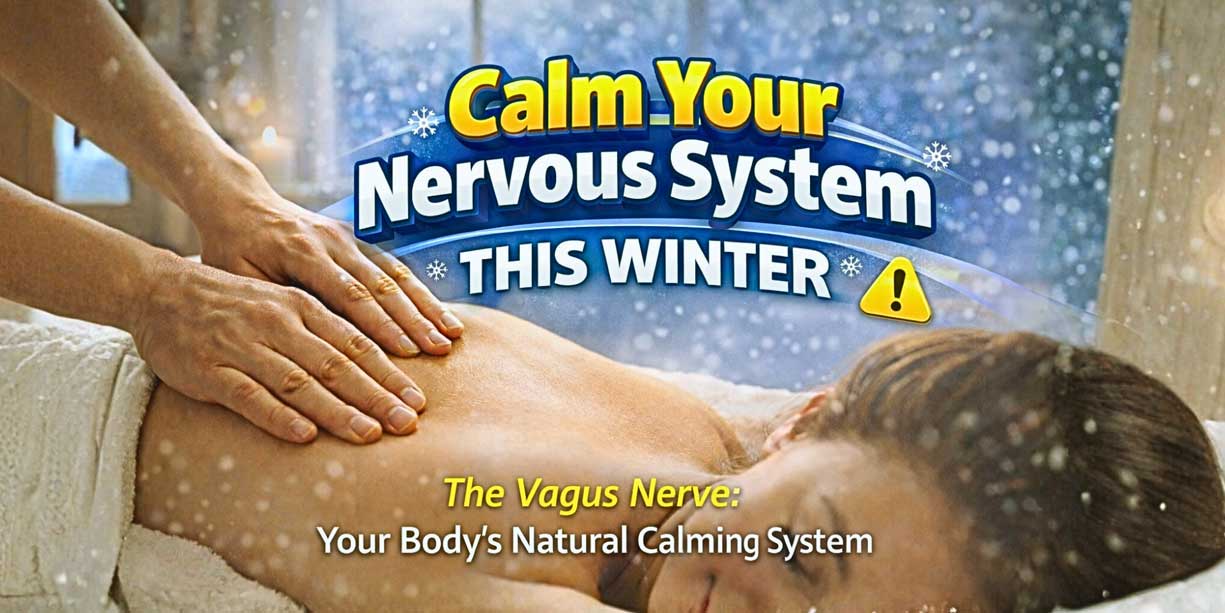
The Vagus Nerve: Your Body’s Natural Calming System
At the center of nervous system balance is the vagus nerve. This nerve is called the “wandering nerve” because it runs from your brainstem all the way down to your large intestine, connecting your brain to almost every major organ in your body. This amazing nerve is your body’s main pathway for turning on the parasympathetic nervous system and helping you feel calm and safe.
The vagus nerve controls your heart rate and blood pressure, digestion and gut health, immune system and inflammation, emotional regulation and stress response, and the connection between what your body feels and your emotions. Research from Cedars-Sinai has shown that calming activities, including massage, create changes in the brain partly by increasing vagus nerve activity.
When your vagus nerve is working well, you have what researchers call good “vagal tone.” This means your body can easily shift from stress to relaxation, bounce back from challenges faster, and maintain better overall health. Poor vagal tone leaves you feeling stuck in fight-or-flight mode, unable to fully relax even when you’re safe and trying to rest.
Scientists measure vagal tone by looking at heart rate variability—the variation in time between your heartbeats. Higher heart rate variability usually means better nervous system health and stress resilience. Multiple studies have shown that massage therapy can significantly improve heart rate variability, which means it’s boosting your parasympathetic nervous system.
How Massage Therapy Helps Your Vagus Nerve
Understanding vagal tone—how active and responsive your vagus nerve is—helps explain how massage creates real, lasting benefits. Higher vagal tone means better stress resilience, lower resting heart rate, improved digestion, less inflammation, better mood, and overall nervous system balance. Researchers measure vagal tone through heart rate variability, where increases show stronger vagal activity and better nervous system health.
A major 2020 study published in Scientific Reports looked at different massage techniques and their effects on relaxation. Researchers compared vagus nerve-focused massage with gentle shoulder massage and a rest-only control group. They measured changes in heart rate variability and how relaxed people felt.
The results were impressive. Both massage approaches led to big increases in heart rate variability compared to the control group, showing that the parasympathetic nervous system was being activated. People also reported feeling much less stressed and more relaxed. What’s really interesting is that even gentle shoulder massage was very effective at helping the vagus nerve work better. This shows that different types of massage can support nervous system health. Relaxation-focused massage therapy seems especially good for improving vagal tone because it helps shift your body from fight-or-flight mode to rest-and-digest mode.
Three Ways Massage Helps Your Vagus Nerve
Direct Stimulation of the Vagus Nerve
The vagus nerve has branches throughout your body, with some running close to the surface in your neck near major muscles like the trapezius and sternocleidomastoid, in your ears, and in other areas. When massage therapists apply medium pressure to these spots, they wake up sensory receptors that connect directly to the vagus nerve. These receptors send signals to your brainstem, which then increases parasympathetic activity throughout your body.
Research consistently shows that medium pressure—not too light and not painfully deep—applied to the neck and shoulder areas produces the biggest increases in parasympathetic activity. This is why the amount of pressure during massage really matters. Too light won’t properly wake up the receptors. Too aggressive might actually trigger a stress response instead of relaxation. Skilled massage therapists know this balance and adjust their pressure to what works best for each person.
Activating Pressure Receptors All Over Your Body
Even massage on areas far from the vagus nerve’s main pathways can significantly improve vagal tone. When therapists work on your back, hands, feet, or other body parts, they stimulate pressure receptors in your skin and muscles. These receptors send information into your nervous system that ultimately affects how your vagus nerve fires.
This creates helpful effects like slower heart rate, deeper and more regular breathing, less cortisol (the stress hormone), and stronger feelings of safety and relaxation. Interestingly, massage on any part of your body can help vagal activity by encouraging slower, deeper breathing. As you relax during massage and your breath naturally deepens, nerve fibers in your lungs send signals through your brainstem that further help vagus nerve function. This creates a positive cycle where physical relaxation leads to deeper breathing, which creates even more relaxation.
The Overall Relaxation Effect
The combined effect of massage is a complete shift in nervous system balance. As fight-or-flight activity decreases and rest-and-digest activity increases, real physical changes happen. Studies consistently show increases in high-frequency heart rate variability—the specific measurement that shows vagal activity—after massage sessions.
What’s important to understand is that these effects depend on the type of pressure used. Gentle to medium pressure consistently produces the strongest vagal response and the biggest improvements in nervous system balance. Very deep tissue work, while good for certain muscle problems, might actually trigger stress responses if it’s too intense or done without good communication. This is why relaxation-focused massage therapy is often most effective for improving vagal tone—it creates the perfect conditions for your nervous system to shift into parasympathetic mode.
For Edmonton residents dealing with constant winter stress, this relaxation response is especially valuable. Each massage session gives your nervous system a chance to practice shifting out of fight-or-flight and into rest-and-digest. Over time, with regular sessions, your nervous system gets better at making this shift, improving your overall vagal tone and stress resilience even between appointments.
Trauma, Stress, and How the Body Remembers
One of the most important discoveries about stress and trauma is that these experiences aren’t just stored in our minds as memories—they’re held in our physical bodies. This idea, made popular by psychiatrist Bessel van der Kolk in his groundbreaking book “The Body Keeps the Score,” has changed how we approach healing from stress and trauma.
When you experience stress or trauma, especially if it’s ongoing or overwhelming, your nervous system can get stuck in a defensive state. The natural stress response should involve activation, action, and then completion. But this cycle gets interrupted. Your body prepares to fight or run but never gets to finish that response. This incomplete cycle leaves leftover tension and hypervigilance stored in your tissues, particularly in your fascia—the connective tissue that surrounds every muscle, nerve, and organ.
Research on somatic therapy (body-centered therapy for trauma and stress) has found promising results. A 2021 review published in the European Journal of Psychotraumatology looked at studies on Somatic Experiencing, a specific approach that treats trauma symptoms by changing the body sensations connected with traumatic experiences. The review found early evidence for positive effects on trauma symptoms, as well as improvements in emotional wellbeing and body symptoms in both traumatized and non-traumatized people.
For those dealing with the built-up stress of Edmonton winters, or for people carrying unresolved trauma, body-based approaches through massage therapy offer a way to release what talk therapy alone often can’t reach. By working directly with the physical signs of stress and trauma held in the body, massage helps complete those interrupted stress responses and restore a sense of safety to the nervous system.
Somatic Massage: Releasing What’s Stored in Your Body
Somatic massage therapy is a specialized approach that combines traditional massage techniques with awareness of how stress and trauma are held in the body. Unlike massage focused only on tight muscles or relaxation, somatic work specifically addresses the nervous system patterns that keep you locked in states of high alert or shutdown.
During somatic-informed massage sessions, therapists work with several key ideas. They focus on creating a feeling of safety, because the nervous system can only begin to release defensive patterns when it feels safe. The therapist’s presence, pacing, and communication all help establish this foundation. They watch your body’s responses in real-time, noticing subtle changes in breathing, muscle tone, and nervous system activation that show your nervous system is shifting states. They work within your tolerance zone—the space where you can process sensations and emotions without becoming overwhelmed or shutting down. And they encourage body awareness, helping you notice and accept the sensations in your body rather than disconnecting from them.
Research on body-oriented trauma therapies has consistently shown positive results. Studies show that approaches like myofascial release, which addresses restrictions in the fascial system, can effectively release tension and stored trauma from the body’s connective tissue. When fascia becomes restricted due to stress, injury, or trauma, it loses its ability to move freely, creating areas of tension, pain, and reduced movement. Sustained pressure techniques can help release these restrictions, allowing people to feel lighter with greater ease of movement and wellbeing.
For Edmonton residents, applying somatic principles in massage therapy can be especially valuable during winter months. The constant low-level stress of short daylight, cold temperatures, and seasonal routine changes creates layers of tension that build up over time. Regular somatic massage sessions provide chances to actively release this buildup before it becomes chronic pain or more serious nervous system problems.
Specific Massage Techniques for Nervous System Health
At The Self Centre, our registered massage therapists use various techniques specifically chosen to support nervous system health during Edmonton winters. Understanding which approaches work best for your individual needs helps create the most effective treatment plan.
Therapeutic Massage with Vagal Focus works on the key areas where the vagus nerve pathway runs close to the surface. Our therapists apply medium, sustained pressure to the neck and shoulder area, particularly between the trapezius and sternocleidomastoid muscles, and at the base of the skull. Research has shown that this focused work significantly improves heart rate variability and promotes parasympathetic activation. The massage is done at a pace and pressure that feels calming rather than aggressive. This is critical because medium pressure effectively activates the receptors connected to vagal nerve pathways, while painful or overly aggressive pressure can actually trigger stress responses, working against the benefits you’re seeking.
Relaxation Massage for Vagal Enhancement is one of the most effective approaches specifically for improving vagal tone. Unlike deeper work aimed at releasing specific tight muscles, relaxation massage uses gentle to medium pressure with flowing, rhythmic strokes designed to promote overall parasympathetic activation. This approach is particularly powerful for nervous system regulation because it creates perfect conditions for your body to shift from fight-or-flight into rest-and-digest mode. Studies show that this style of massage produces the most consistent increases in high-frequency heart rate variability—the key marker of vagal activity. For people whose nervous systems are stuck in constant fight-or-flight due to Edmonton winter stress, trauma history, or ongoing life challenges, relaxation-focused massage provides the safety and predictability needed for the vagus nerve to improve its tone and responsiveness.
Craniosacral Therapy offers an extremely gentle approach that works with the subtle rhythms of the craniosacral system. This technique is particularly good for calming an overactive nervous system and can help with headaches, jaw tension, and the kind of mental overwhelm that often comes with Edmonton winters. The light touch used in craniosacral work makes it especially appropriate for people with trauma histories or those who find deeper pressure overwhelming.
Myofascial Release targets the fascial restrictions that develop in response to chronic stress and trauma. By applying sustained pressure to areas of restriction, therapists help restore the fascia’s natural gliding properties. This work can be profound for releasing long-held patterns of tension and can sometimes bring emotional releases as the body lets go of stored stress. A thorough understanding of how trauma is held in fascia guides this approach, ensuring that releases happen at a pace your nervous system can handle.
Breathwork Integration recognizes that breath is one of the most direct ways to influence nervous system state. Throughout massage sessions, our therapists may guide you in breathing practices that enhance vagal activation. Slow, belly breathing stimulates the vagus nerve through its connection to the respiratory system and can significantly enhance the calming effects of massage. Studies have shown that controlled breathing exercises can improve heart rate variability and reduce blood pressure in people with stress-related conditions.
Rhythmic, Flowing Techniques that follow the body’s natural rhythms can be especially effective for nervous system regulation. Rather than working in a scattered or inconsistent way, therapists use continuous, predictable movements that help your nervous system settle into a state of safety. This approach is especially valuable for people whose nervous systems are in a state of hypervigilance, as the predictability and rhythm provide anchoring signals that it’s safe to relax.
The Science Behind Massage and Winter Wellness
The scientific research provides strong support for massage therapy as a treatment for stress, anxiety, and nervous system problems. A 2022 analysis looking at somatic experiencing showed positive outcomes for trauma, anxiety, and somatic symptom disorders, with improvements in heart rate variability consistently noted across studies. Another study found that massage therapy combined with somatic awareness techniques worked better for trauma and chronic stress than massage alone, highlighting the value of integrating body awareness into hands-on therapy.
The ways massage supports winter wellness are many. At the brain chemistry level, massage has been shown to reduce cortisol while increasing serotonin and dopamine—brain chemicals connected with mood regulation and feelings of reward and pleasure. This brain chemistry shift directly counters the seasonal changes that contribute to winter mood problems. Research specifically addressing seasonal affective disorder has explored various body-based therapies, recognizing that body-focused treatments can complement other approaches.
At the physical level, massage improves circulation, which can be especially helpful during cold months when blood flow to your hands and feet may be reduced. Better circulation supports tissue healing, reduces inflammation, and contributes to an overall sense of warmth and vitality. The improved immune function connected with regular massage is especially valuable during flu season and times when people are gathering indoors where illness spreads more easily.
At the nervous system level, massage provides direct feedback to the brain that the body is safe, it’s okay to let down defenses, and relaxation is possible. This bottom-up approach to nervous system regulation—working from body sensations toward thoughts and emotions—can be more effective than top-down thinking approaches alone, especially when dealing with stress and trauma that’s stored in the body.
Creating Your Winter Wellness Plan
If you’re experiencing the effects of Edmonton winter on your nervous system—whether through increased anxiety, disrupted sleep, constant tension, or seasonal mood changes—incorporating regular massage therapy can be life-changing. Research suggests that regular sessions, rather than one-time treatments, provide the most benefit for nervous system health and vagal tone.
When beginning massage therapy for nervous system support, consider starting with weekly sessions if you’re dealing with acute stress, high anxiety, or are in the middle of particularly difficult winter months. This frequency allows your nervous system to build on each session’s effects, creating cumulative benefits. As your symptoms improve and your resilience increases, many people transition to every-other-week or monthly maintenance sessions.
Communication with your massage therapist is essential. Share information about your stress levels, sleep quality, any trauma history that might be relevant, areas where you hold tension, and what sensations feel calming versus overwhelming to you. This information helps your therapist tailor the session to your nervous system’s specific needs and ensures the work stays within your comfort zone.
Between sessions, practices that support vagal tone can enhance the benefits of massage. These might include daily breathwork practices, spending time in nature when possible—even brief winter walks in daylight can provide benefits, cold exposure like ending your shower with brief cold water, which research suggests can help vagus nerve pathways, gentle movement practices like yoga or tai chi, mindfulness meditation, and maintaining social connections, as positive social interaction also supports nervous system regulation.
Why Choose The Self Centre for Nervous System Support
At The Self Centre in South Edmonton, our registered massage therapists bring specialized knowledge in nervous system regulation and body-based approaches to healing. We understand that Edmonton winters require more than standard relaxation massage—they demand therapeutic treatment that addresses the unique stressors our community faces.
Our therapists are trained to recognize signs of nervous system imbalance and to work with trauma-informed principles that ensure your safety and comfort throughout treatment. We create a calm, supportive environment designed specifically to help your nervous system downregulate. From the moment you enter our clinic, our space communicates safety, allowing your body to begin the shift from sympathetic activation toward parasympathetic restoration.
We take time to understand your individual experience, recognizing that winter affects each person differently. Some clients struggle primarily with mood and energy, others with sleep and anxiety, and still others with chronic pain that worsens in cold weather. By tailoring our approach to your specific nervous system patterns and needs, we provide care that creates meaningful, lasting change rather than temporary relief.
Many of our clients report that regular massage therapy has transformed their experience of Edmonton winters. Instead of simply surviving the dark months, they find themselves with greater resilience, improved mood, better sleep, and a sense of being more connected to their bodies. The cumulative effects of supporting your nervous system through consistent massage therapy can shift your entire relationship with winter from one of survival to one of relative thriving.
Moving from Survival to Thriving This Winter
Edmonton winters will always be long, dark, and cold—that’s simply the reality of our northern location. But how your nervous system responds to these challenges doesn’t have to leave you feeling depleted, anxious, and disconnected. Through massage therapy that specifically supports vagal function and addresses the body-based impact of stress and trauma, you can build the resilience and regulation your nervous system needs to navigate winter with greater ease.
The research is clear: massage therapy effectively activates the parasympathetic nervous system, improves heart rate variability, reduces stress hormones, and helps release trauma and tension stored in the body. For Edmonton residents facing the combined challenges of seasonal darkness, cold temperatures, and the stress of extended winter, these benefits translate into real improvements in daily quality of life.
You don’t have to accept winter as a time of reduced wellbeing. By prioritizing your nervous system health through regular massage therapy, you invest in your body’s natural capacity for regulation, resilience, and healing. Whether you’re dealing with seasonal mood changes, chronic stress, unresolved trauma, or simply the built-up tension of navigating life in one of Canada’s coldest cities, massage therapy for the nervous system offers a pathway forward.
Visit The Self Centre in South Edmonton and discover how supporting your vagus nerve and releasing stored stress through skilled, trauma-informed massage therapy can transform your winter experience. Your nervous system has been working hard to keep you safe through challenging conditions. Give it the support it needs to not just survive, but to find calm, balance, and wellbeing even in the depths of an Edmonton winter.
To learn more about our massage therapy services and book your appointment, visit theselfcentre.com or contact our South Edmonton clinic directly. Let this winter be the one where you discover what it feels like to have a balanced, supported nervous system carrying you through the cold months with resilience and strength.